


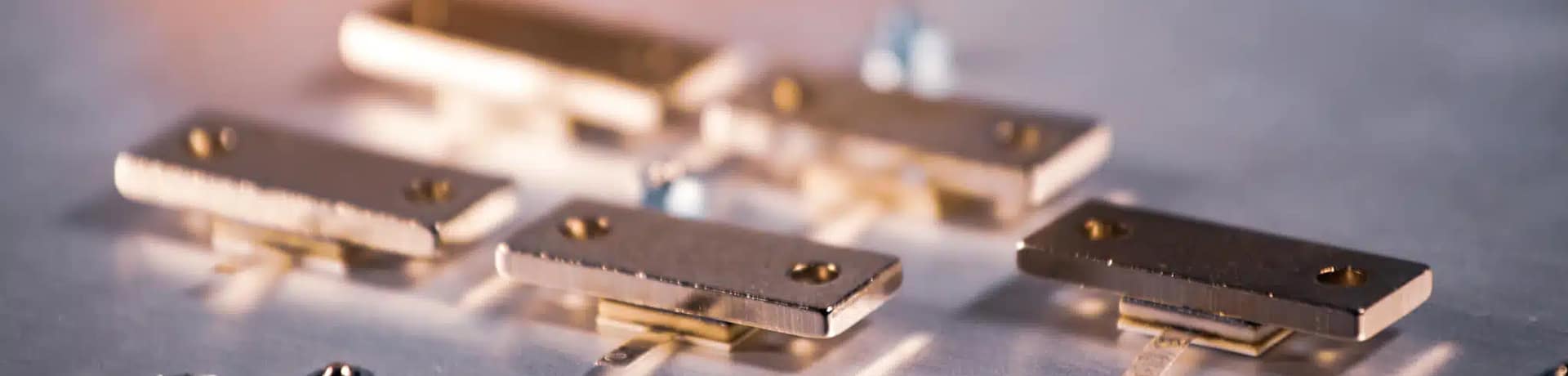
Nickel-Tin Plated Busbars are a real alternative

If you manufacture, specify, or purchase busbars, you have several factors to consider, including conductor material, dimensions, and surface area. The choice of plating material is another important consideration, with implications for overheads, durability and electrical performance.
While precious materials like silver and gold offer valuable properties such as excellent conductivity and corrosion resistance, on specific projects and budgets, their expense can make alternative finishes worth considering where the specification allows.
In this article, our plating team will explore how choosing nickel-tin plating (nickel undercoat and tin coating on top) can offer a more economical, cost-effective alternative to precious metal coatings like silver and gold for busbar applications, whilst meeting performance and durability requirements where suitable.
With the correct surface preparation, dual‑layer nickel–tin electroplating is commonly used on copper and aluminium busbars to combine tin’s low cost and good contact behaviour with nickel’s hardness and barrier properties.
Why Nickel and Tin Plating is a Cost-Effective Choice
In some applications, nickel and tin plating provides a more economical alternative to the busbar electroplating process without compromising on quality.
Why add nickel instead of using tin alone?
Due to their reactive nature, including oxidisation, some aluminium and copper busbars cannot be directly plated with tin or silver. Plating directly onto the base metal can lead to interaction between the tin coating and the material underneath it, which on copper happens through intermetallic diffusion, where the tin and the copper gradually migrate into one another at the interface, and on aluminium comes from galvanic interaction between two dissimilar metals that are in contact.
You will sometimes hear this being referred to as “leaching”, and it’s a big problem for many applications as both finish quality and electrical performance suffer over time. The busbar itself is the substrate, so an intermediate layer has to be applied between the base metal and the tin if the finish is going to adhere properly and last in service. Surface preparation with nickel plating serves as an excellent intermediary layer, enabling effective tin plating. On aluminium busbars in particular this combination improves conductivity, because plating replaces the insulating oxide film that forms on the bare metal with a stable and conductive surface, and it also enhances corrosion resistance, which makes it a reliable and cost-efficient solution.
Copper Busbars: Enhancing Performance
As highly conductive as copper busbars are, they are prone to oxidation and corrosion, especially in demanding environments such as high‑temperature applications, automotive, and humid or chemically active atmospheres. Electroplating is often required to maintain long‑term electrical performance and reliability.
Plating copper busbars with a combination of nickel and tin provides a highly durable busbar with a balance of protection and electrical performance. The nickel underlayer acts as a barrier and offers excellent high‑temperature stability, corrosion resistance, and mechanical durability. Over this, the tin top layer provides a low‑contact‑resistance, solderable surface that resists oxidation and reduces the formation of insulating copper oxide films.
The combination improves contact reliability, helps maintain low contact resistance, and extends service life, making nickel‑under‑tin plated copper busbars a preferred choice for many industrial and automotive power‑distribution systems.
Aluminium Busbars: Overcoming the Oxide Layer
Aluminium busbars behave differently to copper, because as soon as the bare metal is exposed to air it forms a hard oxide layer across the surface, and that layer makes for a poor contact surface wherever the busbar has to carry current across a joint.
Unlike copper, you cannot simply put an aluminium busbar straight into the plating line, as it needs a number of preparatory steps beforehand, and if those steps are not carried out properly then the quality of the finished busbar will be affected.
Once the surface has been prepared correctly, electroplating with nickel and tin improves adhesion and increases hardness, which is useful in applications where the busbar has to stand up to handling and mechanical wear, while the tin top layer gives the finished busbar a stable, low contact resistance surface with good solderability.
Reducing Costs with Nickel and Tin Plating
Unlike costly alternatives like silver and gold, nickel and tin plating offers a budget-friendly approach. Tin, in particular, is significantly cheaper while still delivering excellent conductivity and corrosion resistance. Nickel, when used as a base layer, ensures strong adhesion and a dense, corrosion-resistant surface. This combination is particularly advantageous for:
- Aluminium busbars – Achieving a reliable plated surface without the high cost of alternative metals.
- Copper busbars – Providing enhanced durability and heat resistance for high-temperature applications.
Use nickel plating to reduce the risk of tin whiskers
One common issue with tin plating is the formation of “tin whiskers”—tiny, hair-like structures that can cause short circuits in electronic applications. According to various electronic research sources, the nickel base layer significantly mitigates this risk by acting as a barrier, effectively delaying and reducing whisker growth, especially on copper busbars. This added reliability translates to long-term cost savings by minimising the need for more frequent maintenance and replacements in some applications.
Extended Lifespan and Lower Maintenance Costs
Nickel and tin-plated busbars require less routine maintenance compared to uncoated or alternative metal finishes. The superior wear resistance and durability provided by this plating combination reduce the frequency of replacements, further cutting down costs over time.