

Choosing an electroplating company for your busbars is a big decision, with a lot at stake. Even though it’s only one step in the manufacturing and production process, it’s often the first thing that your customers will see. It’s also the first interface that any connectors, joints and terminals will meet, and that’s before we even look at whether a plating partner can meet the volumes you need and the specifications your bars need to pass quality inspections.
The right busbar plater is the one that can prove it can handle your products, deliver a quality finish, and meet your volumes and specifications. At Karas Plating, we’re a specialist busbar plating business, and we speak to a lot of buyers, so we’ve put this guide together to help you choose an electroplating partner. Work through this checklist before you ask for quotes, and ask every plater the same questions so you can compare the answers fairly. You can also request a printable copy of the checklist at the end of this guide.
Quick Links

- What to get right first
- Technical support
- Capacity
- Will the finish perform in service?
- Certifications
- Regulations
- Can they plate to my specification?
- Processes
- Will they deliver when they say?
- Communication
- How will your busbars be stored and delivered?
- Trial and approval
- Approval process
- Things you may also consider before talking to an electroplating company
- Warning signs
- FAQs
- Download the printable checklist
What to get right first
Start by gathering the documents and information for your stock. This can include:
- Drawings, CAD or STEP files
- What material your busbars are made from, such as aluminium, copper, CCA or brass (often called the substrate or base metal)
- What finish you would like, such as silver, tin or nickel
- The size and dimensions of your busbars
- The weight of your busbars
- The quantities of products to be plated, and whether they are all being plated in one run or demand will be in batches
- Whether the busbars are already in the field, have existing plating or are new
Technical support
When you’re looking for an electroplating partner, you’re not just looking for someone to process your busbars. Technical support matters just as much, and you may find that talking to your plating partner about the process can help you as early as the design stage of your project.
For example, when talking to your plating partner about tin plating, bear in mind that tin can grow fine whiskers over time. This matters where conductors such as busbars sit close together, so ask them how they manage that risk.
Sometimes you use a different electroplating partner and your bars end up with the wrong finish or needing rework. As it’s not always possible to buy new copper, you can ask your electroplating partner whether they can strip the existing finish and replate, and whether this is possible given the condition of your busbars.
Good technical advice saves time and helps avoid rework. For example, aluminium needs pretreatment and a nickel undercoat before it can be silver plated, so you can discuss how that’s done, the potential for underlayers to improve durability and surface finish, and how masking is done, including whether this is done in house or by the electroplater.
The electroplating partner can also help identify what material your busbars are made from and advise you on the finish.
What an electroplating partner can help you with
This is not just about plating your busbars or saying, ‘Oh, can you plate this?’ An electroplating partner can advise you on the finish and the different types of finishes available. With tin, for example, you can have a matte tin finish, often called a dull finish, or a bright tin finish. It’s the same with nickel, where you can have an electroless nickel plating finish or an electrolytic finish.
Your plater can advise on finish, thickness and contact faces, but conductor size and current rating are design decisions for you or your busbar maker, so it’s always worth asking what technical advice is included.
Not every project is straightforward. There will likely be some questions or details that aren’t defined yet, especially on large projects with a few moving parts. That’s where talking to the plating partner helps, so you need a partner with the technical knowledge to support you. The questions they can help you answer include:
- Checking whether the finish can be achieved. Some plating systems need specific pretreatment, process controls or an intermediate layer to meet the required performance. For example, aluminium needs a nickel undercoat before it can be silver plated, while copper doesn’t.
- Do you need the whole bar plated, or just parts of the bar?
- What finish do you need, if you don’t already know?
- Where is the stock currently located, and what logistics are needed?
- Are the bars processed before or after plating, such as bending or punching?
Capacity
Capacity is another key factor for busbar manufacturers and fabricating companies. If you are dealing with the demanding industries that need busbars, such as power distribution, renewable energy, industrial applications and data centres, the volumes are usually very specific, so you need a plating partner that can handle the tonnage your customers need.
Even if your plating partner promises to do a certain amount at a time, consistency between batches depends on effective process control. Changes in loading, racking, bath condition or operating parameters can create variation if they are not controlled and checked. This can lead to a higher number of defects per million opportunities (DPMO), more customer rejections, late deliveries and damage to your brand image.
Capacity questions also help you plan your business. For example, by finding out the bar sizes a line can handle, you can then plan whether oversized bars may need to be sent somewhere else, handled by a different process or require a new line. A plater that’s small relative to your volume can easily become your bottleneck when dealing with large customer orders and projects.
If subcontracted plating is used, you want to make sure that this is accounted for. You also want to avoid having to switch partners partway through, for example, two years into a project. You can ask:
- What’s the largest bar your line takes, by length, width and weight?
- What throughput can you commit to for my quantities?
- Is the plating done in your own plant?
- How would you scale if my volumes grow?
When it comes to capacity, a good electroplater can really come into their own and become an extension of your business, an extension of your production line and a valuable partner. A good electroplater will tell you things like how many busbar shifts per week they can offer, how many kilos and tonnes they can process, and whether dedicated lines are available. They can even go as far as putting together a specific plan for your work and providing a dedicated line.
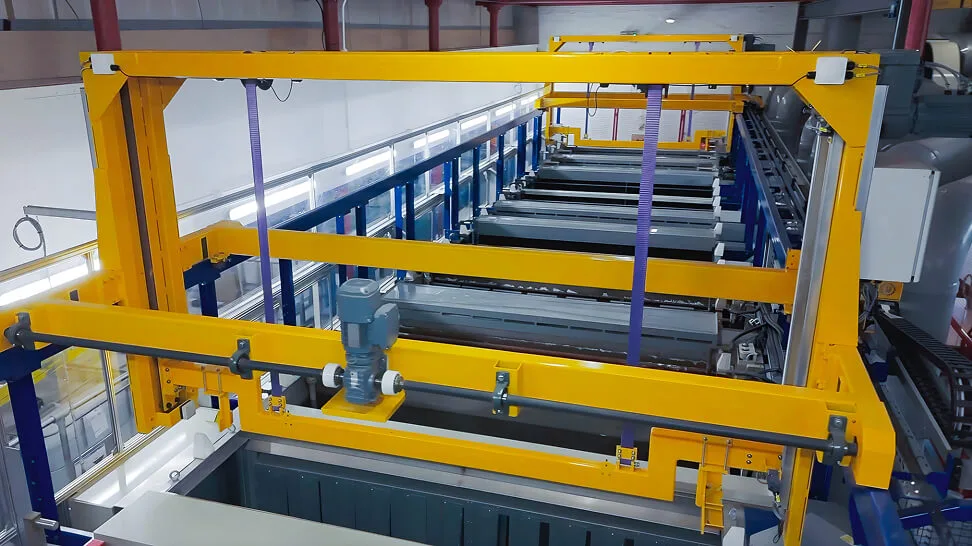
For example, at Karas Plating, we offer 2.4 metre plating lines and even go as high as 4.2 metre plating lines. Some of our lines can process up to 200 kg every 20 minutes, and our annual processing capacity is over 4,500 tonnes. We have manual plating lines, extra wide plating lines and automated plating lines, all dedicated to meeting the needs of our customers.
Will the finish perform in service?
Electroplating is not just about cosmetics. When looking for a busbar plating company, check whether their work is cosmetic plating or functional and industrial plating. Your product not only needs to look good but also needs to perform in the field, as failure means downtime for your customers and, in turn, costs you business.
Before committing to a supplier, ask whether they can share some previous projects with you. Some of these will be confidential, so they may give you general examples instead. This shows you that the busbars they have plated are out in the field and that they have a track record.
Some plating partners can offer site visits so that you can take a look at their facilities, see what the production process will be like and, most importantly, see some real plated products. For large repeat orders, this is especially valuable, as seeing the work in person can settle any concerns you have.
Certifications
When working in certain industries and supplying to certain customers, you will know how important certifications and quality standards are to your customers. They can be the difference between winning a large order and losing it to a competitor. So during the selection process, check which certifications the plating supplier holds. These can include:
- ISO 9001, which is commonly expected as evidence of documented quality management, process control, traceability, inspection and corrective-action systems.
- ISO 14001, for environmental management, particularly because plating involves regulated chemicals, wastewater and waste handling.
- ISO 45001, which shows an occupational health and safety management system is in place and is often expected in large OEM supply chains.
- Customer, OEM or sector approvals, as some industries have their own requirements.
Regulations
- REACH, which restricts certain hazardous substances, including lead and hexavalent chromium, in relevant applications.
- RoHS, especially if the busbar will go into electrical or electronic equipment sold in the UK or EU.
Can they plate to my specification?
One of the most important things for your busbar products is meeting the specification for the application. This goes beyond your plating partner’s certifications and focuses on the product itself, and whether the plating process meets the specification or not. There is a wide range of plating processes and requirements that apply to busbar products, depending on your industry. Here are some of the standards a drawing might call up.
Coating standards may include:
- ISO 2093 for electroplated coatings of tin and tin alloys
- ASTM B545 for electrodeposited tin coatings
- ASTM B700 for electrodeposited silver coatings for engineering use
- ASTM B689 for electrodeposited engineering nickel coatings
Other requirements may include:
- BS EN IEC 61439, where the busbar forms part of a low-voltage switchgear or controlgear assembly
- BS EN 13601, where relevant to the copper strip or base material used for electrical purposes
- IATF 16949 or customer-specific automotive requirements, where relevant to the supply chain
The standard should come from you or your customer, on the drawing or purchase order. A plater won’t usually choose one for you, because they often don’t know who the end customer is or how the bars will be used, for example whether they’ll run hot or be painted afterwards. Put the standard on your drawing or order, pass on anything you know about the end use, and ask the plater to show that standard on the certificate of conformity. You can, however, ask the plater for advice on processes and process control, and draw on their knowledge and experience.
Share these with your plating partner at the time of enquiry. Sometimes an NDA is needed before you share the information, but this will help your partner judge whether they can deliver to that specification or not.

How bars are jigged can make a difference to both plating thickness and price. Plating them back to back fits more on each jig and keeps the cost down, but the faces in between get less plating. If your drawing sets a minimum, say 2.5 microns of silver, the plater can either plate a little thicker, such as 3 to 5 microns, so every face stays above it, or turn the bars so fewer fit on each jig, which can roughly double the price. A good plater talks these options through with you before quoting.
Processes
When picking a supplier, the process matters too. We have discussed the quality of the finish and how it will perform in service, but what often gets overlooked is the process itself. This may matter less if you are working on small or single projects. However, if you are a large multinational copper or aluminium supplier, fabricator or manufacturer, it pays to think ahead when picking a supplier for busbar surface treatment. Can you grow with your partner?
For example, a classic situation we often see here at Karas is that you need silver plating for your busbars this year, but what happens if the customer requests a different finish, you have a new project coming up that requires a different finish, industry specifications get updated or new inventions come up? If your plating partner can only provide one process at one dimension, then you have to start the process of picking a supplier all over again, which costs time and resources.
Process control also affects the quality of your products, so asking a few questions about the measures they have in place can help you make sure you are getting the product you have specified.
Start by asking how the plater keeps the plating consistent across different batches. Just having one good batch does not mean the rest will be OK. A good plater will test its plating solutions regularly and keep records. If projects run for long periods, you may also want to find out how often they test and adjust their plating solutions, because any changes need to be caught early to avoid drift.
You should also find out whether they carry out checks during their plating runs, and not only at the end, to catch any potential problems early.
Will they deliver when they say?
It’s also worth asking about delivery times and logistics. Do they have a defined delivery date for orders? How long does it take them to process orders, and what capacity measures do they have in place? You may also need to know whether this is fixed or flexible, for example, when demand suddenly spikes and you need a quick reaction. A partner you can trust and rely on lets you make realistic promises to your customers that you can actually keep.
Lead times often differ from one finish to another, so ask for a figure for each finish rather than one answer for everything. You can ask:
- What’s your typical lead time for each finish on repeat work?
- Can you turn round an urgent batch, and what does it cost?
- Can you hold capacity for scheduled orders?
Communication
Communication is another item to evaluate. How quickly does the plating company get back to you when you put in an enquiry? How quick are they with quotes, changes and general communication?
Check who your point of contact will be and whether they are easy to reach once you start working together. You also want to know how you can follow order progress, what happens when something goes wrong, and who you can speak to about your order, changing volumes, increased capacity, future updates and batches.
When plating busbars, it’s not just the plater that is in the mix. Your customers need to be kept updated, and so does your production team. There will be times when you need to plan projects around your electroplating partner.
Good communication means you get early warning and have time to replan. If you need to talk to someone, you have a named person with their direct phone number and email address to contact. There’s a clear process, and you can keep control.
How will your busbars be stored and delivered?
This seems like a light item on a checklist, until you realise that you are potentially shipping copper or aluminium worth thousands. Packaging is a good example. If the supplier does not have proper packaging, your shiny, brand new aluminium busbars could get damaged in transit, which can affect performance in the field.
Secondly, if you are expecting your supply chain to go from your factory to the plater and from the plater to the end customer to cut delivery delays and costs, how the plated stock arrives at your customer’s site reflects directly on your brand.
Also, if you are shipping your stock, you need to know that it will be stored safely and securely. This matters for just in time supply, for example, if you need to keep some of the stock closer to the customer or have an inventory management system. Ask whether your supplier offers storage and how much product they can hold at a time.
Add shipping to the checklist too, and find out whether they can offer transport for deliveries and collections. Even if you are using a delivery company, it’s still worth checking whether their site is suitable for accepting deliveries. When handling busbars, this can mean two or three lorries with trailers arriving each day. If they do not have space for parking and logistics, this can quickly cause delays.
The same applies to collections. Do they have staff available for collections, and at what times can you collect?
Make sure your plating partner has the equipment to handle the stock, such as forklifts, so that it does not get damaged and is handled properly and shipped back.
Trial and approval
For many projects, you need a surface treatment supplier that you can actually work with. For large orders, for example, you are not going to get the provider to process a large batch without seeing how it comes out, whether it meets the specification and whether it will satisfy your customer. If your chosen partner does not have a trial process, that introduces risk into your production process.
This can also include first article inspection, which allows you to inspect the first few parts of a new job against the drawing before the rest of the order is plated. For plating, that means thickness readings at the points on the drawing, plus adhesion, appearance, selective areas and masked threads. The results go in a report for approval, meaning later batches can be produced and inspected against the agreed drawing, specification, approved sample and control plan. It can be repeated after a drawing revision or a process change.
Approval process
In that trial and approval process, another thing on your checklist should be change notifications from your busbar plating supplier. When you specify a product for plating in large quantities, you want certainty that the products will be plated the same way every time. Changes your supplier should tell you about include:
- Changes in the cleaning or pretreatment steps
- New chemicals or plating chemistry
- Changes in plating thickness testing or measurement
This is where site visits and consultations really help, as they can iron out any uncertainties that you, your customer or your technical team might have. This is why, at Karas, we offer full capability to support prototypes, trials and validations with the necessary industry qualifications, such as PSW and PPAP. This helps ensure that customers are satisfied with the products, that the products meet the specifications and that any issues are picked up before full production.

Things you may also consider before talking to an electroplating company
Busbars work in a wide range of applications. There may be things about how yours operate that differ from other busbars, and this may change how they are plated. So it’s worth having a conversation with your plater early on. Yes, it may affect the process, as adjustments may need to be made, or even new plating lines developed to suit your application’s design. At Karas Plating, we often develop new plating lines for custom orders to make sure the customer gets their desired specification.
Before you contact an electroplating partner, these are the things you may need to prepare to ask or tell them:
- The required coating thickness, including nominal and minimum local thickness where specified, and the measurement points on the drawing
- Whether a nickel or other barrier layer is required beneath the final finish
- Any required testing, such as thickness, adhesion, corrosion resistance or electrical contact resistance
- Any permitted rack marks or contact points, particularly where electrical contact areas must remain fully plated
- Whether any bending, punching, machining, welding, soldering or other processing will take place after plating
- Packaging requirements, including separation and anti-tarnish protection where relevant, particularly for silver-plated parts
- How many you need now and later, from a sample or prototype through the first batch to repeat or annual volumes, for planning and lead times
- Whether your bars will arrive in stock lengths or already cut, drilled, punched and bent, for plating process decisions
- Exactly which faces need plating, marked on the drawing, for busbars that aren’t getting the whole surface plated
- One finish per part number, with a standard on the drawing that matches it. If you need the same bar with and without a nickel undercoat, give each version its own part number.
- Any tapped holes, threads or inserts, and whether they should be plated or masked
- Where the bars will work, including temperature, vibration and whether they sit indoors or outdoors
Warning signs
When evaluating your busbar plating supplier, or any supplier of surface treatments for busbars, watch out for these warning signs:
- No defined or clearly outlined lead times
- No confirmed size limits
- No questions asked about what the base metal is, what finish you require or the quantities
- No information about process changes or updates
FAQs

What should I send a plater to get an accurate busbar quote?
To get an accurate quote for plating busbars, send a drawing with the base metal, finish and thickness, and any specifications the product needs to meet. You can also contact us or use the busbar plating quotes tool to get your quote.
You can go into as much detail as you need, for example, stating that the whole bar needs to be plated or marking any areas that need plating or masking. If you include how many bars you need now and in the future, and how they’ll arrive, you’re more likely to get a price straight away instead of a list of questions.
Should my busbars be plated in silver, tin or nickel?
There is no single answer to picking silver, tin or nickel plating for busbars, as it depends on the application, environment and specifications. In general, silver plating gives high conductivity and suits joints carrying high current. Tin costs less than silver and protects the copper base well in most switchgear and distribution work. Nickel is harder and stands up to harsh or hot conditions, often as a layer under tin or silver. However, this is more of a design and specification decision than a plating one, and your plating company can talk you through the options.
How thick should busbar plating be?
Your drawing or applicable specification should set the coating thickness. This should normally include the nominal thickness, minimum local thickness, measurement locations and the areas to which the requirement applies. Thickness varies with the finish, application and service conditions, and your plating company can advise on suitable options and how the coating will be measured
Can I plate just the ends of my busbars?
Yes, many busbar platers can plate only the contact areas, such as the ends and connection faces. Mark those areas clearly on your drawing and say how any holes or threads should be treated. With silver, this can cut the cost noticeably.
Can a plater confirm the current rating of my busbars?
It’s not always possible for an electroplating company to confirm the current rating of your busbars. The plater can advise on finish, thickness and contact faces, but conductor size and current rating are design decisions for you or your busbar maker.
Download the printable checklist